

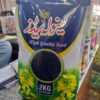
Canola seed 2kg


₨ 300₨ 3,000 (-90%)
Breeder seed
🌱 Hybrid Canola Characters (F1 Types)
1. Morphological Characters
Plant height: 90–160 cm (hybrids usually taller & stronger stems).
Growth habit: Erect, semi-compact.
Leaves: Bluish-green, waxy coating, lobed, with smooth or slightly serrated margins.
Flowers: Bright yellow, self-pollinated but insect-aided cross-pollination occurs.
Pods (siliques): 4–8 cm long, containing 15–30 seeds.
Seeds: Small, round, dark brown to black.
—
2. Agronomic Characters
Maturity: Early to medium duration (90–120 days depending on hybrid & climate).
Yield potential: 25–35% higher than open-pollinated (OP) varieties.
Oil content: 38–46%.
Seed rate required: Lower than OP (2–3 kg/acre vs. 3–4 kg/acre).
Lodging resistance: Stronger stems, less lodging.
—
3. Quality Characters
Double-zero (00) quality:
Erucic acid: <2% (heart-healthy oil).
Glucosinolates: <30 μmol/g meal (safe for livestock feed).
High protein meal: 35–40% protein after oil extraction.
Fatty acid profile:
Oleic acid: 55–65%
Linoleic acid: 18–25%
Alpha-linolenic acid (omega-3): 8–12%
—
4. Stress & Disease Resistance
Drought tolerance: Better than OP varieties.
Heat tolerance: Improved seed setting in high temps.
Disease resistance: Many hybrids carry resistance/tolerance to:
Blackleg (Leptosphaeria maculans)
Sclerotinia stem rot
Clubroot
Alternaria blight
—
5. Advantages of Hybrid Canola over OP Varieties
Higher yield stability.
Early maturity (fit into crop rotations).
Lower seed rate requirement.
Uniform growth & maturity → easier harvest.
Better oil quality (low erucic acid, high omega-3).
Stress & disease tolerance.
—
✅ In summary: Hybrid Canola (F1) combines high yield, double-zero oil quality, disease resistance, and early maturity, making it far superior to traditional open-pollinated varieties.
Additional information
| Weight | 2 kg |
|---|


Reviews
There are no reviews yet.